The Secret Sauce of 2026 Streaming: How IP Multicasting Ends the Buffering War
📡 Experience the Power of Multicast Streaming
Our premium IPTV service is built on modern IP Multicasting infrastructure with Edge Node distribution and full H.266 support — zero buffering, guaranteed. Start your free trial today.
THE END OF BUFFERING: WHAT CHANGED IN 2026?
We've all been there: it's the final minute of a championship game, the score is tied, and just as the star player takes the shot, the screen freezes. A spinning circle appears. By the time the image returns, the game is over. In the early days of streaming, this was an accepted frustration. But in 2026, with the move to native 8K resolution and AI-curated live feeds, buffering has become a relic of the past.
The technology responsible for this seamless experience is IP Multicasting. If you want to understand how modern IPTV services deliver crystal-clear 8K content to millions of people simultaneously without crashing the internet, you need to understand how this protocol works.
UNDERSTANDING THE BASICS: UNICAST VS. MULTICAST
To appreciate multicasting, you first have to understand the traditional way video is sent over the internet: Unicast.
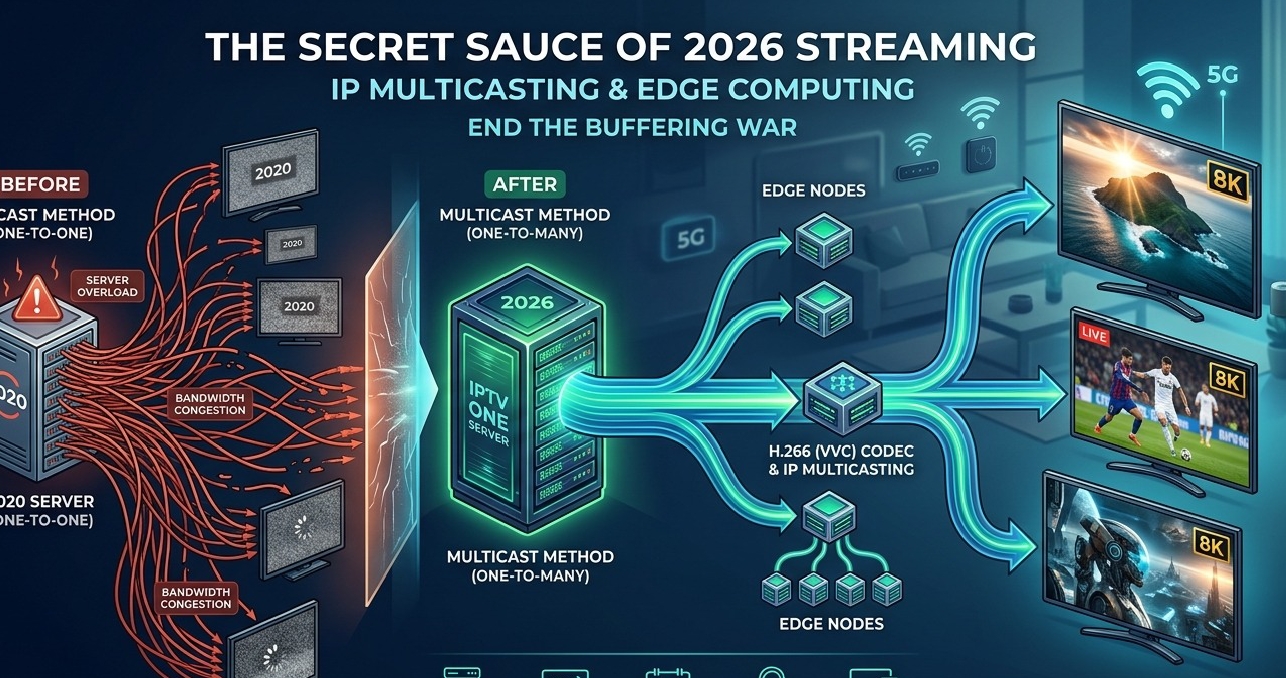
📤 The Unicast Method (One-to-One)
In a Unicast system, if 1,000 people want to watch a live stream, the server has to send 1,000 individual copies of that data.
The Problem: Massive redundant traffic. Each 8K stream at 50 Mbps means the server needs a 50 Gbps connection just for 1,000 viewers.
The Result: Overloaded servers, clogged ISP pipes, and everyone buffering at the same time.
📡 The Multicast Method (One-to-Many)
IP Multicasting works more like a traditional broadcast. Instead of a unique copy for every viewer, the server sends one single stream to a specific multicast group address.
Network routers replicate it only when necessary — if ten people on the same street are watching the same channel, the ISP sends one stream to that neighbourhood's local node, which then splits it for those ten houses.
HOW IP MULTICASTING STOPS BUFFERING
In 2026, IPTV providers use IP Multicasting to solve the three main causes of buffering: server load, bandwidth congestion, and high latency.
Eliminating Server Bottlenecks
The source server outputs a single stream regardless of whether there are ten viewers or ten million — hardware is never overloaded, keeping the source constant and high-quality.
Reducing Congestion with Edge Computing
Modern IPTV uses Edge Computing to move data nodes closer to your location. 8K data is cached and replicated at a local node just miles from your home, eliminating long-distance traffic jams.
Optimising for H.266/VVC
The H.266 (VVC) codec allows 8K streaming at roughly the same bandwidth 4K once required. Combined with multicasting, total infrastructure load is reduced by over 70% compared to 2020 standards.
THE TECHNICAL "WHY": NEAR-ZERO LATENCY
⚡ 5G & 6G Integration
In 2026, the integration of 5G and 6G networks has brought latency to near-zero levels. Multicasting is the perfect partner for these high-speed networks because it prevents "jitter" — the tiny timing variations that cause video to stutter. By keeping the data flow consistent and one-way, the stream enters your device's buffer at the exact same rate it is being played back.
IS YOUR IPTV SERVICE USING MULTICASTING?
While the technology is standard for major platforms, not all third-party providers have made the leap. When choosing a service in 2026, look for these Trust Pillars:
Anti-Freeze 5.0 Protocols
Often marketing terms for proprietary multicasting and error-correction layers built on top of the core protocol.
Edge Node Support
Check if the provider mentions local servers or "Edge" distribution — a clear sign they're using modern multicast infrastructure.
H.266/VVC Compatibility
If they still only offer H.264, they aren't leveraging the efficiency gains of modern multicasting. Walk away.
FINAL THOUGHTS
IP Multicasting is the "invisible" hero of 2026. It is the reason we can enjoy live 8K sports on a smartphone while riding a train, or why a household can have four different TVs streaming UHD content simultaneously without a single hiccup.
By shifting from the "one-to-one" model of the past to the "one-to-many" model of the future, we have finally won the war against buffering.
READY TO STREAM WITHOUT LIMITS?
Join a service that's built on the same multicast infrastructure we just described — 8K-ready, edge-distributed, and buffer-free.
Start Your Free Trial →